History of PAS
Archived here is a brief history of the Phoenix Astronomical Society, along with several other documents of historical interest. This history will be updated as the story of PAS unfolds. It highlights major events and turning points in our organization rather than serving as a complete historical record.
Research for this history drew on old newsletters, meeting minutes, membership rosters, Arizona Corporation Commission filings, college yearbooks, and personal conversations. Thanks are due to Keith Parizek, one of our founding members; Jim Conley and Jerry Belcher, two of our early members; and Leonard Rodriguez and Barbara Stratton of the Phoenix College Office of Alumni and Development, for their invaluable assistance in reconstructing this story. Compiled for this website in May 2005, it represents the first and best attempt at a comprehensive accounting of the evolution of our organization — a legacy for future PAS historians to continue.
Timeline at a Glance
1948
Phoenix Observatory Association · Phoenix College
Founded by Amos Hoff, Prof. of Physics — Phoenix College faculty since 1937.
1968
Club-funded and ground 24" f7 telescope installed on the Phoenix College campus.
1973
Telescope de-commissioned.
1974
Phoenix Astronomical Society
Incorporated as a 501(c)(3) non-profit. Newsletter: Sky-Lines.
1975
Phoenix College
New Cassegrain optics for the Amos Hoff 24" reflector, ground by optician Don Loomis, unveiled November 21. Members toured Lowell Observatory's Andrews Mesa site in October, viewing the 13" astrocamera used to discover Pluto.
1975
Observatory proposed for Paradise Valley Park (near Paradise Valley Community College). Proposal denied; 24" mirror sold and installed in a private observatory near Alpine, AZ.
1980
Phoenix Astronomical Society · Phoenix College
Bruce Lanard elected President, with Steve Coe — later a noted deep-sky observer and author — as Vice President. Dr. Arthur Hoag, Director of Lowell Observatory, spoke on current research programs including the Hubble constant.
1984
New logo adopted.
1985
Newsletter renamed PAStimes.
1986
Brophy Prep
Meeting location changed.
1999
Valley Academy
Meeting location changed.
2001
pasaz.org domain registered for email.
2002
Website hosting at pasaz.org / geocities.com. Became a member of the Astronomical League.
May 2003
Arizona Science Center
PAS ran an Astronomy Day "Space Stations" event with NASA, the U.S. Geological Survey, Lowell Observatory, and the International Dark Sky Association, drawing hundreds of families for hands-on astronomy activities.
August 2003
Arizona Science Center
Mars made its closest approach to Earth in nearly 60,000 years; PAS set up 17+ telescopes for a packed public Mars-viewing event.
2004
Foothills Academy
Meeting location changed.
March 2005
Arizona State University
PAS joined the Sally Ride Science Festival at ASU, offering solar viewing and handing out hundreds of donated Sky & Telescope magazines to encourage girls in science.
2006
Paradise Valley Community College
Meeting location changed.
April 2006
Foothills Academy
Dr. Jeff Hester of ASU — imaging lead for the Hubble Space Telescope's iconic "Pillars of Creation" photograph — spoke at a special meeting.
October 2006
Members voted to amend the club's constitution.
February 2007
Paradise Valley Community College
PAS officers called a special meeting to consider sponsoring a scale-model Solar System plaque on the PVCC campus.
September 2007
PAS ran regular "dark sky" star parties at sites near Sedona/Cottonwood and Black Canyon City's High Desert Park, alongside public star parties at Paradise Valley Park.
February 2008
University of Alberta physicist Dr. Don Page spoke on "Does God So Love the Multiverse?"
July 2008
Mayer, AZ
PAS opened a new dark-sky observing site, with the club funding a portable restroom for member star parties there.
September 2009
ASU student and Mars Desert Research Station veteran Veronica Ann Zabala-Aliberto opened the season as guest speaker.
October 2009
Arizona State University
PAS members previewed ASU's inaugural Earth and Space Exploration Day at the October meeting.
September 2010
PAS marked the 400th anniversary of Galileo's telescope discoveries with a lecture on NASA's planned Europa-Jupiter System Mission.
December 2010
University of Arizona planetary scientist Richard Greenberg, author of "Unmasking Europa," spoke on the moon's icy surface.
February 2011
PAS began organizing against CVEMS electronic billboards — like the one at Anthem Outlet Mall — as a growing threat to Arizona's dark skies.
December 2011
Dr. David Williams previewed NASA's Mars Science Laboratory (Curiosity) rover, which launched later that month.
May 2012
PAS covered the annular solar eclipse of May 20 with a dedicated special newsletter issue.
June 2012
PAS covered the transit of Venus — an event that won't recur until 2117 — with a dedicated special newsletter issue.
May 2013
PAS held its annual officer elections (Bruce Wurst elected President) and Awards Ceremony, including a youngest-member honor for Rockie Hervieux.
December 2013
Retired chemist and longtime member Earl DeLong presented "The Chemistry of the Cosmos."
February 2014
PAS held a silent auction of four original 1969 Life Magazine issues covering the Apollo 11 Moon landing, with proceeds benefiting the club.
November 2014
Frequent PAS speaker Dr. David Williams of ASU was elected a Fellow of the Geological Society of America; asteroid 10,461 DAWilliams was named in his honor.
July 2015
NASA's New Horizons became the first spacecraft to fly by Pluto — a world discovered from observations made at Arizona's Lowell Observatory — an event PAS tracked on its own club calendar.
November 2015
WWII veteran and longtime member John C. Pulis passed away at 93; PAS had celebrated his 90th birthday with him in 2012.
March 2016
Guest speaker Ted Blank shared that he moved to Arizona and joined PAS after attending the club's 2012 Venus Transit event as a visitor.
May 2016
PAS's fight against light-pollution-causing electronic billboards scored a win with the legislature's defeat of HB 2507.
March 2017
Five PAS members timed a stellar occultation by asteroid 113 Amalthea, contributing data toward determining the asteroid's size and shape.
August 2017
Members experienced the "Great American" total solar eclipse and shared photos and videos at the following month's meeting.
May 2018
Members proposed founding an Astrophotography Special Interest Group.
October 2018
Black Mountain Campus, PVCC
PAS celebrated its 70th anniversary with a special celebration event.
September 2019
PAS's Annual Scholarship program was announced, organized by Sam Insana; James Arnold became its first recipient in early 2020.
November 2019
Lowell Observatory historian Kevin Schindler spoke on the observatory's 125th "Quasquicentennial" anniversary.
April 2020
PAS moved entirely to remote Zoom meetings during the COVID-19 pandemic, including its first virtual officer elections that May.
September 2020
Longtime PAS speaker Klaus Brasch was honored by Lowell Observatory, which named asteroid 25226 Brasch for his volunteer service.
2020
pasaz.org website redesigned on Google Sites.
April 2021
Sam Insana — a beloved former PAS President and longtime leader of the club's outreach and occultation programs — passed away. The scholarship established the following year was named in his memory.
August 2022
The Phoenix Astronomical Society / Sam Insana Memorial Scholarship established, honoring former PAS President Sam Insana.
October 2022
Klaus Brasch surveyed "A Half Century of Astronomical Photography," tracing the technology's evolution from the era of the first daguerreotype of the Moon.
October 2023
PAS held public viewing events for the year's annular "ring of fire" solar eclipse.
April 2024
Members prepared for the total solar eclipse crossing North America — partial from Arizona — with safety reminders for observers and their families.
March 2025
The newsletter's cover feature covered that month's total lunar eclipse, a "blood moon" visible across Arizona.
Our Founder
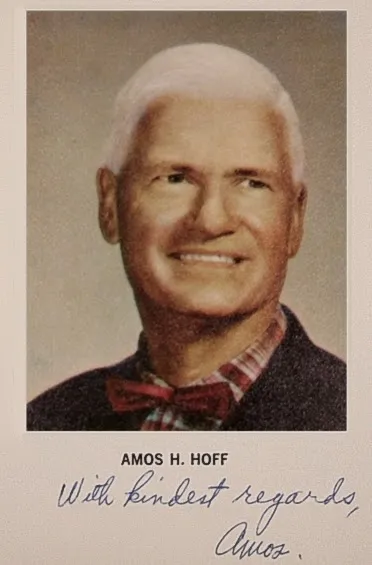
Amos Hoff joined the faculty of Phoenix College (PC) in 1937. PC was a junior college at the time, located at 1202 West Thomas Road. In that year he taught physics, mathematics, and engineering shop, and sponsored their astronomy and radio clubs. During his 30 year tenure at PC he served in many positions, including chair of the physics and engineering departments. He earned his B.A. at Manchester College and his M.S. at Northwestern, and was working towards his doctorate at U. of A. at the time of his retirement in 1967. Hoff passed away in 1987 in California. His lifelong enthusiasm for science, and his love of astronomy, carried over into all his endeavors. During his first ten years at PC he developed a vision for public education in astronomy that ultimately led to the creation of PAS.
As early as November 1943, Hoff was teaching a Phoenix College astronomy class that doubled as training in celestial navigation for students headed into aviation. "The astronomy class has been emphasizing aerial navigation as well as astronomy, since most of the class is interested in aviation training," Hoff told the campus yearbook staff, after his students used the school's 5-inch refractor to locate Venus in the middle of the afternoon. "We are studying astronomy, meteorology, and celestial navigation."
By 1946-47 Hoff had founded and was moderating the college's Astronomy Club, built around that same Clark Brothers 5-inch refractor — by yearbook accounts, "one of the finest telescopes in the west" available to Phoenix at the time, and one of its most active and successful years. That early class and club were the seed from which the Phoenix Observatory Association, and later PAS, grew.
Under the leadership of Keith Parizek, PAS Treasurer at the time of Hoff's passing, it was decided that a special lecture event should be held in his honor — the Amos Hoff Memorial Lecture.
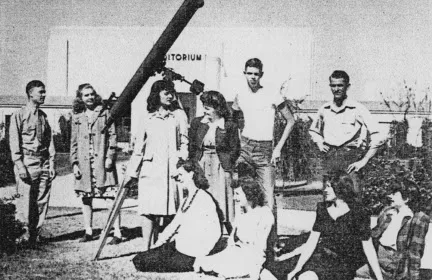
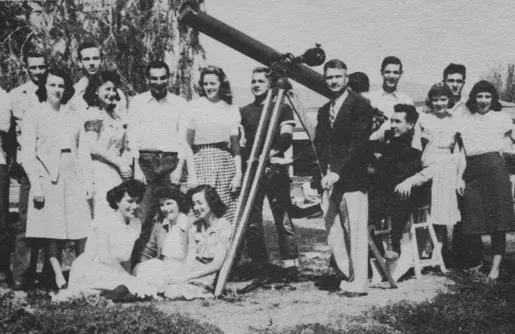
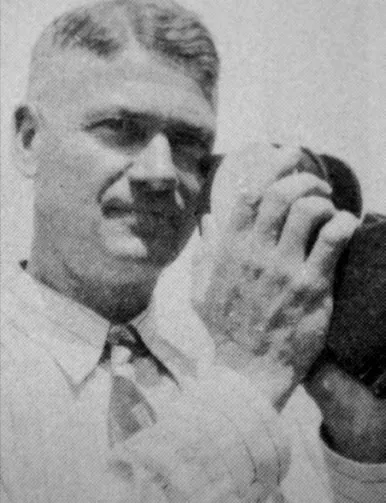
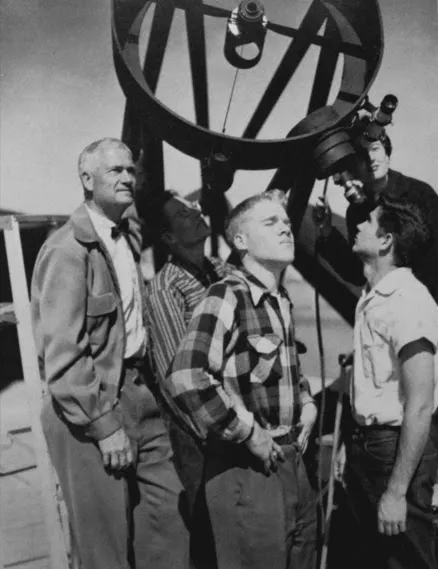
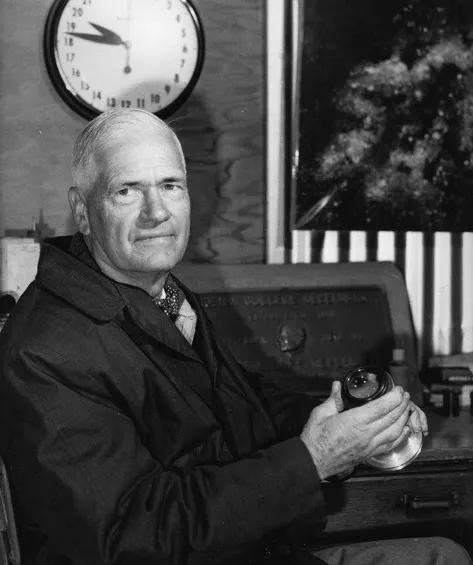
Photos courtesy of the Phoenix College Office of Alumni and Development, from PC yearbook archives.
The Phoenix College Years
In 1948 Amos Hoff, then Professor of Physics at PC, founded the Phoenix Observatory Association (POA). This group of professional and amateur astronomers was motivated by a grand vision — the construction of a public observatory for the promotion of astronomy. Arizona at that time enjoyed the precious resource of a clear and dark night sky. A 24 inch pyrex mirror blank was obtained and rough grinding was done in an orange grove near downtown Phoenix. This work was done manually and required much effort by a lot of strong arms and hands. The effort to figure the mirror floundered until Jimmy Corn, Phoenix police officer and master optician, took the lead. This resulted in a finished mirror that was good even by professional standards, figured as a 24 inch f7 Newtonian. The mount and housing for this mirror was built by the same group.
The original site for the proposed observatory was on some empty land at 19th Avenue and Dunlap, near the canal (which was at that time way out in the "country" and had good dark sky). In the interim, Hoff wanted the scope at Phoenix College where it would be more convenient for students and visitors to use. Hoff prevailed. In 1968 the mirror and mount were installed in an electrically powered roll-off building on the PC campus parking lot for use by POA and PC students. Placing the scope at PC resulted in a lot of disappointment by the original group who constructed the telescope, and they gradually lost interest. The seeing was greatly compromised by the heat generated by the asphalt paving at PC.
Negotiations with the Maricopa County Board of Supervisors dragged on. During the 60's and 70's the POA met regularly at PC developing this vision and furthering their own education in astronomy. The retirement of Amos Hoff in 1967 brought many changes. Bill Anderson took over as Professor of Physics at PC and liaison to POA, bringing a totally different management style to the collaboration. Around 1973, due to increases in enrollment and parking demand, PC requested the telescope and building be removed. POA took possession of the equipment and held it in storage pending completion of the observatory project. In 1973 plans for that public observatory were drawn by local architect, and amateur astronomer, Max Kaufman and submitted to the Maricopa County Board of Supervisors. The estimated observatory construction cost of $15,000 was to be financed completely by donations orchestrated through POA. In 1974 Maricopa County rejected the proposal in favor of an equestrian facility replete with the usual glaring arena lighting. It was time to regroup. The observatory project itself, though never completed, was such an ambitious project that it deserves to be remembered.
The Transition Years
In 1974 POA was incorporated as the Phoenix Astronomical Society, a non-profit organization, for the purpose of raising the required funding for the observatory. Surviving issues of the Society's newsletter, Sky-Lines, from this period capture just how active those final Phoenix College years were. On Friday, November 21, 1975, members gathered at PC to inspect newly completed Cassegrain optics for the Amos Hoff 24" reflector, ground by noted Tucson optician Don Loomis, along with slides and movie footage of the mirror being polished and of the telescope in operation on campus — even as plans for a new observatory building, and the mirror's eventual sale, were already taking shape. That same season, the Society's newly formed Astrophotography Group, led by Bill Anderson, met monthly to trade techniques and, in January 1976, uncovered a cache of astronomical slides from the early 1900s in the Phoenix College archives. Members were also tracking the skies themselves — Comet Kobayashi-Berger-Milon brightened to naked-eye visibility that summer, and a nova in Cygnus flared into view that August, prompting S.I. Gale to present slides of it, "particularly noted was its vivid red color as it faded," to the club that fall. In October 1975, members and their families caravanned to Flagstaff for a tour of Lowell Observatory's Andrews Mesa site, hosted by planetary observer Charles Capen — including a look at the 13" astrocamera Clyde Tombaugh had used to discover Pluto, more than a decade before Tombaugh himself would speak to PAS.
In 1975 a second site was selected on a half-acre parcel in what was then the 340 acre Paradise Valley Park, with the Paradise Valley School District as the intended recipient. It was hoped the observatory would stimulate interest in astronomy and serve as a resource for science courses in those schools. Negotiations with the Maricopa County Board of Supervisors faltered, and in 1976 the mirror was put up for auction. Dr. Keith Parizek, POA President 1960-1966, purchased the mirror for $2,600. It was installed at his private observatory in Alpine, AZ shortly thereafter, where it resides to this day. The mount was purchased by Lloyd Horton, then a resident of New River. Its present disposition is unknown.
During the last half of the 70's a schism developed in the membership. A growing number of PAS members felt the organization had lost sight of its original goal — observing. The organization fissioned and gave birth to the Saguaro Astronomy Club in 1976-77, still a major player in AZ amateur astronomy. PAS, diminished but still strong, continued its astronomy advocacy activities at PC through 1985, meeting in Room C-102, the science lecture hall. That building has since been demolished; the old site is now home to PC's new Arts Center.
In 1983, then PAS President Stan Gorodenski organized, with the help of other Officers, the first multi-club observing event at the Filthy Five Park in Black Canyon City. In attendance were members from the Prescott Astronomy Club (PAC), Tucson Amateur Astronomy Association (TAAA), Saguaro Astronomy Club (SAC), and PAS. The effort was continued by the East Valley Astronomy Club (EVAC) and later evolved into what is now the annual All Arizona Star Party, a tradition that continues to this day. During his two-year tenure as President, Stan also created the position of Editor, making it separate from the Secretary/Treasurer position to better divide responsibilities. With the advent of computer technology, the newsletter was rapidly evolving from its original 3x5 card format to a more readable and flexible full-page format with graphics included. The first official Editor was Bill Krist (1982-1983).
In 1984, PAS ran a design contest among its members to come up with an official society logo. Many creative submissions were received. The membership voted to adopt the design of charter member Harold Moorin, which it retains to this day — used on all official society publications, including this website.
The Brophy College Prep Years
In 1986, when PC needed to raise the fee for the use of their facilities, PAS went looking for a new meeting location. Dan Heim, a member of PAS since 1982, was then teaching physics at Brophy College Preparatory (BCP). Brophy is located at 4701 N. Central, just south of Camelback Road and not far from the original meeting site at PC. He negotiated a deal with the administration of BCP wherein PAS would use their Physics Lab for meetings in exchange for free attendance by members of the BCP community. This brought many new members into PAS including BCP faculty and students — three BCP physics students served as PAS President during this period.
Some of our most well-known speakers appeared at this venue, including Clyde Tombaugh (recruited by Keith Parizek for the Amos Hoff Memorial Lecture), Frs. Martin McCarthy and George Coyne of the Vatican Observatory, Tucson space artist Kim Poor, and comet hunter David Levy. As an interesting side note, Levy brought his first photographs of Comet Shoemaker-Levy to a meeting in early 1994, allowing PAS members the first look at this historic comet several months before it crashed into Jupiter.
During the last part of the 90's, PAS membership declined due to some bad management and a less-than-stellar speaker series. In 1998, PAS revised its By-Laws to form a new Constitution that reflected the organizational changes required by lower membership, providing more flexibility and adaptability. One of these changes was the creation of Directorships, appointed by the President, to fulfill specific society functions such as Facilities, Multimedia, and Photographer. In 1999, Heim, now acting as PAS Facilities Director, left BCP and negotiated a similar meeting arrangement with Valley Academy, a small charter school in north Phoenix.
The Clyde Tombaugh Lecture
When PAS founder Amos Hoff passed away in 1987, Keith Parizek, PAS Treasurer at the time, suggested a fitting tribute: an Amos Hoff Memorial Lecture, hosted jointly with the Saguaro Astronomy Club — both societies being progeny of the original Phoenix Observatory Association. The lecture never became an annual series, but the one-time event was a resounding success.
Clyde Tombaugh, discoverer of Pluto, was living in Las Cruces, New Mexico at the time, working with New Mexico State University in support of his Tombaugh Scholars Fund. Parizek — who years earlier had actually corresponded with Tombaugh about construction details for a blink comparator he was building — reached out and invited him to be PAS's premiere speaker. Tombaugh graciously accepted, and the lecture was set for Friday, March 25, 1988, in the gym at Brophy Prep, with seating for hundreds and publicity driven jointly by PAS, SAC, and local media. Clyde and his wife Patsy stayed with the Parizeks in Paradise Valley for the visit, giving PAS and SAC members a chance to spend an informal evening with the discoverer of a planet before the lecture itself.
Prior to the visit, Parizek had scanned the original Pluto discovery plates and printed them on acetate sized for his now-completed blink comparator. After the Tombaughs arrived, Keith asked Clyde if he remembered their old phone conversation about the comparator — which, even decades later, Clyde recalled as "one of the more interesting phone calls he received while at NMSU." Keith invited him to try the apparatus, telling him only that it held some "old plates" related to an asteroid — without mentioning he'd secretly loaded the copied discovery plates. Clyde sat down, peered into the eyepieces, and began toggling between the images. After a few passes, recognition spread across his face. He stood up, still smiling, and said: "Thanks! I just discovered Pluto for the second time."
On the night of the lecture, hundreds of astronomy enthusiasts from around the valley filled Brophy Prep. At 7:45 pm, following a brief introduction from Parizek and then-PAS President Richard Wasson, Tombaugh took the podium and spoke for roughly two hours on his discovery and career, illustrated with a 35mm slide show of highlights from his astronomical life. A question-and-answer period followed, and the evening closed with the chance to purchase an autographed poster commemorating his discovery of Pluto — all proceeds benefiting the Tombaugh Scholar Fund for astronomy majors at NMSU. It remains one of the major events in PAS history, and a fitting tribute to both Hoff and Tombaugh alike.
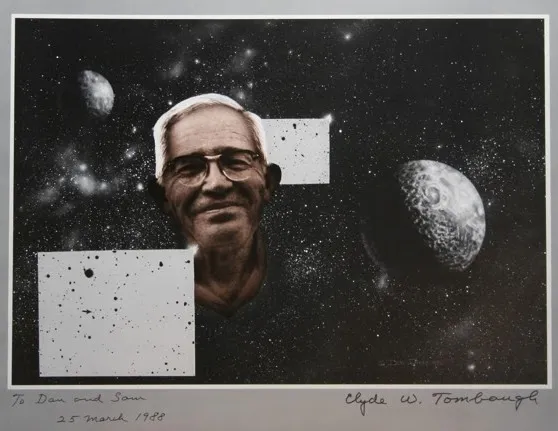
"I Just Discovered Pluto for the Second Time"
Before the lecture, Keith Parizek secretly loaded copies of the original Pluto discovery plates into his blink comparator and asked Tombaugh to try it out, telling him only that it held some "old plates" related to an asteroid.
Tombaugh peered into the eyepieces, toggled between the images, and recognition spread across his face. He stood up, still smiling, and said: "Thanks! I just discovered Pluto for the second time."
Poster image via the Phoenix Astronomical Society archives.
The Valley Academy Years
From 1999 to 2004 PAS held its meetings at Valley Academy at 1520 West Rose Garden Lane. This move took us considerably farther north in Phoenix to an upscale area that held the promise of drawing new members from the school and surrounding community. Perhaps because our meeting venue was now in a "multi-purpose room" that also served as a cafeteria, or perhaps due to continued errors in management and publicity, the expected membership increase never materialized. Initial problems with multimedia capabilities were solved by the purchase and construction of our own equipment, including a multimedia console containing most of what would be needed by our speakers.
In 2002, we became a member society of the Astronomical League. The League consists of hundreds of member societies, and acts as a powerful lobby on behalf of amateur astronomers all over the continent. Through the League we are able to obtain, at a reasonable cost, group liability insurance for our many and varied events.
It was during this era that PAS greatly expanded its outreach efforts, led primarily by Terri Finch, PAStimes Editor. We started doing many more public star parties for schools, church groups, scout troops, and other civic organizations, as well as general and multimedia education events at venues like the Arizona Science Center and the Challenger Space Center. These efforts yielded a small increase in PAS membership and a lot of good publicity. Another of her innovations was a change in the meeting structure to include a separate meeting each month called "Meeting of the Minds." Starting in April of 2003, PAS officers and other interested members began meeting at local restaurants one week before our regularly scheduled meetings for the purpose of handling Society business and planning. This freed up time that would otherwise subtract from what is available to our speakers, and increased the efficiency of our regular meetings.
In another major development, PAS moved into the "cyber age" with the launching of its website by William Finch, our first Webmaster. Having a presence on the internet is almost required these days to compete for membership with the other astronomy clubs in the area. But before any long-term benefits could accrue, another opportunity presented itself for a new and better meeting location. Again, Dan Heim, still acting as our Facilities Director, made a connection with a charter school that had just constructed a new campus in north Scottsdale.
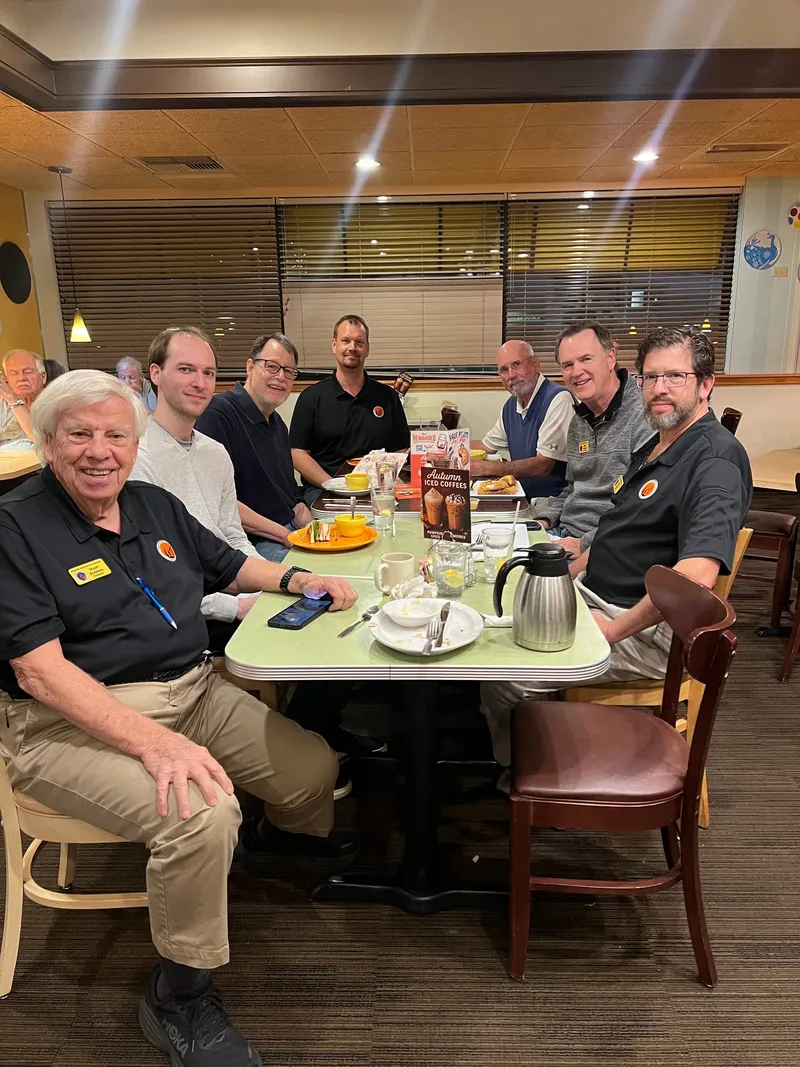
Photo courtesy of PAS members.
The Foothills Academy Year
Our 2004-2005 meeting season was hosted by Foothills Academy College Preparatory (FA) at 7191 East Ashler Hills Drive. Though we are still the Phoenix Astronomical Society, this move took us even farther north out of Phoenix and into north Scottsdale. Constructed in 2003, this school had a beautiful new campus with multimedia-ready classrooms, including digital projection systems and broadband internet access. Serving a largely upscale clientele in this area, it again held the promise of increased membership as well as a more professional venue for our speakers. In a move to reduce expenses, our newsletter PAStimes, under the Editorship of Terri Finch and Matt Kohl, was made available for electronic delivery during the 2004 season. Members with internet access could now download the newsletter directly from our website. In 2005 PAS elected Terri Finch as President, the first woman to hold this position. As a longtime member, and PAStimes Editor from 1993 to 2005, she was eminently qualified to serve us in this capacity.
The Paradise Valley Community College Years
After one year at FA, the membership voted to change our venue to Paradise Valley Community College (PVCC). There were no problems with our previous venue, save for a longer drive for several members, but PVCC presented some excellent opportunities: access to their observatory, larger meeting rooms (their Library and Physics Lab) with full multimedia support, and the chance to collaborate with their own student Astronomy Club. Dave Hellmann, PVCC liaison and Physics Lab Tech, both solicited and facilitated this transition. It was an opportunity too good to pass up — PAS began its 2005-2006 season at PVCC and has been there since.
Black Mountain Campus of PVCC
In 2015, while Sam Insana was president, Aquila Hall opened at the Black Mountain campus of PVCC. Included with the building is a large pad to the west, designed to support up to a dozen amateur telescopes, including power. PAS began holding monthly public star parties there to take advantage of the excellent facilities and darker skies available in Cave Creek. In 2018 an automated observatory was added by the college to the end of the cement pad, including a dome, 14" Schmidt-Cassegrain telescope, and Paramount GOTO mount with cameras and software.
Honor Roll
Some of our distinguished early members, cited in alphabetical order.
Byron Barry
President of POA for 6 years and builder of Pomelo Park Observatory
Max Bray
Founder of Braeside Observatory and professional optician
Lewis Boyd
Pioneer in telescope automation controls
Stan Gorodenski
PAS President (82-83) and coordinator for the first All Arizona Star Party
Lloyd Horton
Expert telescope builder and astronomical resource
Robert E. Hurley
Dome and telescope builder and legal eagle who incorporated our society
Evered Kreimer
Pioneer in cold camera photography and deep-sky explorer
Dick and Helen Lines
Preeminent variable star observers who worked out of their observatory in Mayer
Don Loomis
Master optician for many world-class large telescopes
John Mallas
Co-author of the Kramer-Mallas book "The Messier Album"
Pete Manly
Author of several books on astronomy and telescopes
Harold Moorin
Designer of the PAS logo and first lifetime member
Chuck Nash
Refractor expert and longstanding Treasurer of both POA and PAS
Keith Parizek
President of POA for 7 years, prolific builder of telescopes, mountings, and five observatories
Harry Simmons
Master machinist and telescope mount technician