Start Exploring the Sky
Whether you're eight years old, weighing a career in astrophysics, or just looking for a good star chart — here's where to begin.
Start Here
Four steps from "curious" to "part of the club" — in order, though nothing stops you from skipping ahead.
Learn the Sky Tonight
Open our interactive sky chart and see exactly what's overhead right now from Phoenix — no download, no account.
Open the Sky ChartCome to a Public Star Party
Free, no telescope or experience required. Look through a real eyepiece and let a member walk you across the sky.
Find the Next OneGet Hands-On Help With a Telescope
Own a scope you can't figure out, or need help picking one? PAS runs free telescope workshops throughout the year.
See WorkshopsJoin PAS
Ready for more? Membership gets you the newsletter, the telescope loaner program, and a community that won't tire of your questions.
Become a Member
Kids Corner
Astronomy is one of the few sciences where a curious kid and a professional researcher can look at the same sky on the same night. These are good places for young astronomers to start.
NASA Space Place
NASA's site built for elementary-age kids — games, hands-on craft activities, and plain-language answers about planets, stars, and space technology.
NASA Kids' Club
Games and activities for younger kids straight from NASA, covering rockets, astronauts, and life in space.
NASA Learning Resources
NASA's full hub of lessons, activities, and materials for students and families, organized by grade level and topic.
ESA Kids
The European Space Agency's children's site, with stories and activities about the solar system, the universe, and life as an astronaut.
Interactive Sky Chart
See exactly what is overhead tonight from Phoenix with our interactive sky chart, right here on the PAS site — no download, no account.
NASA's Eyes on the Solar System
A free, real-time 3D model of the solar system, built by NASA/JPL from actual mission data — fly through it, fast-forward or rewind time, and see why a planet is or is not visible tonight.
Kids are welcome at every PAS public star party, and looking through a real telescope beats any website. See upcoming events to find the next one.
FAQ: Astronomy Careers
Questions we hear from students and parents at outreach events, answered generally — a professional astronomer or a school counselor can give you advice specific to your situation.
- Do I need a PhD to work in astronomy?
- For a research astronomer position — at a university, national observatory, or NASA center — a PhD in astronomy, astrophysics, or physics is the standard path. But plenty of careers in the field do not require one: telescope and instrument operators, engineers, software and data specialists, planetarium educators, and science communicators all work in astronomy without a doctorate.
- What should I study in high school and college?
- Build the strongest math and physics foundation you can — astronomy is a physics-heavy field. Programming is close behind, since modern astronomy runs on large datasets. At the undergraduate level, a physics or astronomy major is the usual route, and many working astronomers majored in physics before specializing in graduate school.
- Is astronomy the same thing as astrophysics?
- In practice the terms overlap almost entirely, and departments use them interchangeably. Where people draw a distinction, "astronomy" leans toward observing and cataloguing what is out there, while "astrophysics" emphasizes the underlying physics of how those objects work.
- What jobs exist besides being a research astronomer?
- Observatory and telescope operations, instrument and optical engineering, spacecraft mission operations, scientific software and data science, museum and planetarium education, science journalism, and the aerospace industry. The analytical and computational skills an astronomy degree builds also transfer well outside the field.
- How do I get started right now, before any of that?
- Observe. Learn the sky with your eyes and a pair of binoculars, keep a record of what you see, and get to know other observers — a local club like PAS is one of the easiest ways to do all three. Hands-on time under the stars is what sustains the interest that carries people through the coursework later.
Where to read more
Astronomy Resources
Sites PAS members actually use — for planning a night out, keeping up with the field, and going deeper.
Plan Your Observing
- StellariumFree desktop planetarium software
- Heavens-AboveSatellite passes and ISS predictions
- Sky Conditions & Observing SitesOur Phoenix-area forecast and dark-sky site list
News & Magazines
- Sky & TelescopeObserving guides and monthly sky highlights
- Astronomy MagazineNews, equipment reviews, and beginner guides
- EarthSkyDaily "what to look for tonight" posts
Organizations
- Astronomical LeagueStructured observing programs and awards
- DarkSky InternationalLight pollution advocacy and resources
- AAVSOVariable star observing for amateurs
- ALPOLunar and planetary observing programs
Space Agencies & Imagery
- NASAMissions, news, and image libraries
- Astronomy Picture of the DayA new astronomical image daily since 1995
- European Space AgencyEurope's missions and science results
Contribute to Real Science
- ZooniverseCitizen science projects, including galaxy classification
- NASA Citizen ScienceOfficial NASA-affiliated volunteer projects
Learn Alongside Other Observers
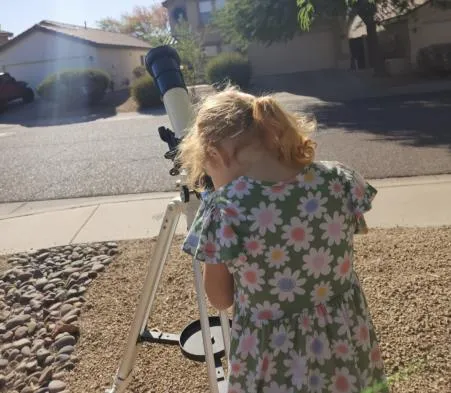
Reading about the sky is a good start; sharing an eyepiece with someone who knows it well is better. PAS runs free telescope workshops and public star parties throughout the year.
External resources on this page are third-party sites chosen as generally recognized starting points, not PAS endorsements, and the careers answers are general guidance rather than club-authored advice.